
Beyond the Pilot: How to Measure Whether a Tokenization Project Is Working
Practical performance measures including operating costs, processing times, investor participation, and capital raised.
Introduction
Many tokenization projects launch as pilots and never graduate to production. Measuring whether a project is actually working requires looking past the press release and into the operational and commercial numbers. This article covers the practical performance measures that separate a working tokenization program from a one-time demo.
Why Measurement Matters
A successful pilot proves a concept; a working program delivers recurring value. Without clear metrics, a project can look busy — integrations built, tokens minted, press posted — while failing to deliver the cost, speed, access, or capital benefits that justified it. Measurement is what turns a pilot into a program and a program into a business, and the absence of it is what lets a pilot drift indefinitely without ever becoming real.
Operating Costs
Compare servicing costs before and after tokenization. A real benefit shows up as lower cost per transaction, per investor, or per distribution over time. If tokenization adds cost rather than reducing it, the case is weak. Track legal, technology, transfer-agent, and compliance costs, and compare them to the legacy baseline — not to zero.
Processing Times
Settlement, transfer, distribution, and onboarding times should improve meaningfully versus the legacy baseline. Define the baseline, measure the current state, and track the trend. Faster settlement that investors cannot actually use because of transfer restrictions is not a real benefit. Measure end-to-end time, not just the blockchain step.
Investor Participation
- Growth in the number of holders over time
- Secondary-market volume and turnover
- Repeat participation across offerings
- Diversity of investor types — retail, institutional, geographic
- Retention of holders between distributions
Capital Raised and Recycled
Total capital raised, retained, and recycled through the platform is the ultimate commercial test of whether the model scales. A platform that raises once and stops is a pilot; one that raises repeatedly, attracts new investors, and recycles capital is a business. Track not just the first raise but the second and third.
Compliance and Error Rates
A working program has low error rates on distributions, accurate record-keeping, and clean compliance outcomes — no missed KYC refreshes, no failed transfers, no regulatory findings. Operational quality is a performance measure in itself, and it usually matters more than any single efficiency metric.
Reporting and Transparency
Does the platform produce timely, accurate reports for investors and regulators? Are distributions reconciled and audited? Reporting quality is both a measure of program health and a driver of investor trust — and investor trust is what makes participation grow.
A Practical Dashboard
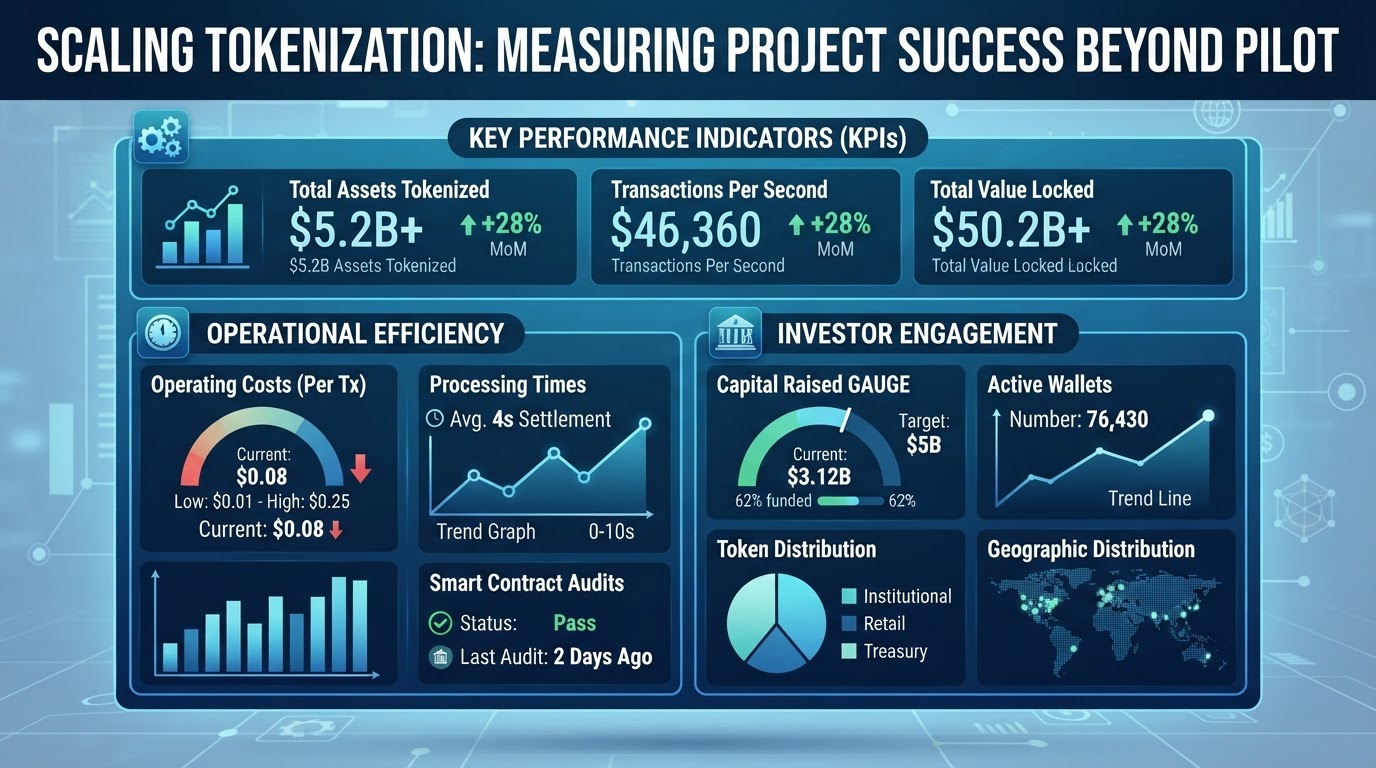
A credible measurement framework tracks operating cost per unit, processing times, investor participation, capital raised, compliance outcomes, and reporting timeliness — over time, against a baseline, and with targets. The dashboard that does not improve between quarters is the one that tells you the pilot is not becoming a program.
Conclusion
A tokenization project is working when its operational and commercial metrics improve sustainably — not when a pilot completes successfully once. Measure operating costs, processing times, investor participation, and capital raised over time, against a baseline, and the numbers will tell you whether the pilot is becoming a program. The project that cannot show improvement on these measures is not yet working, no matter how polished the pilot looked.