Smart Contract Audits: What They Check and What They Cannot Guarantee
Audit scope, common findings, upgrade controls, and the limits of code reviews.
Introduction
A smart contract audit is a core step in launching a tokenized asset, but it is not a guarantee. Audits have a defined scope, find common classes of bugs, and improve confidence — but they cannot prove a contract is safe. This article covers audit scope, common findings, upgrade controls, and the limits of code review.
What an Audit Checks
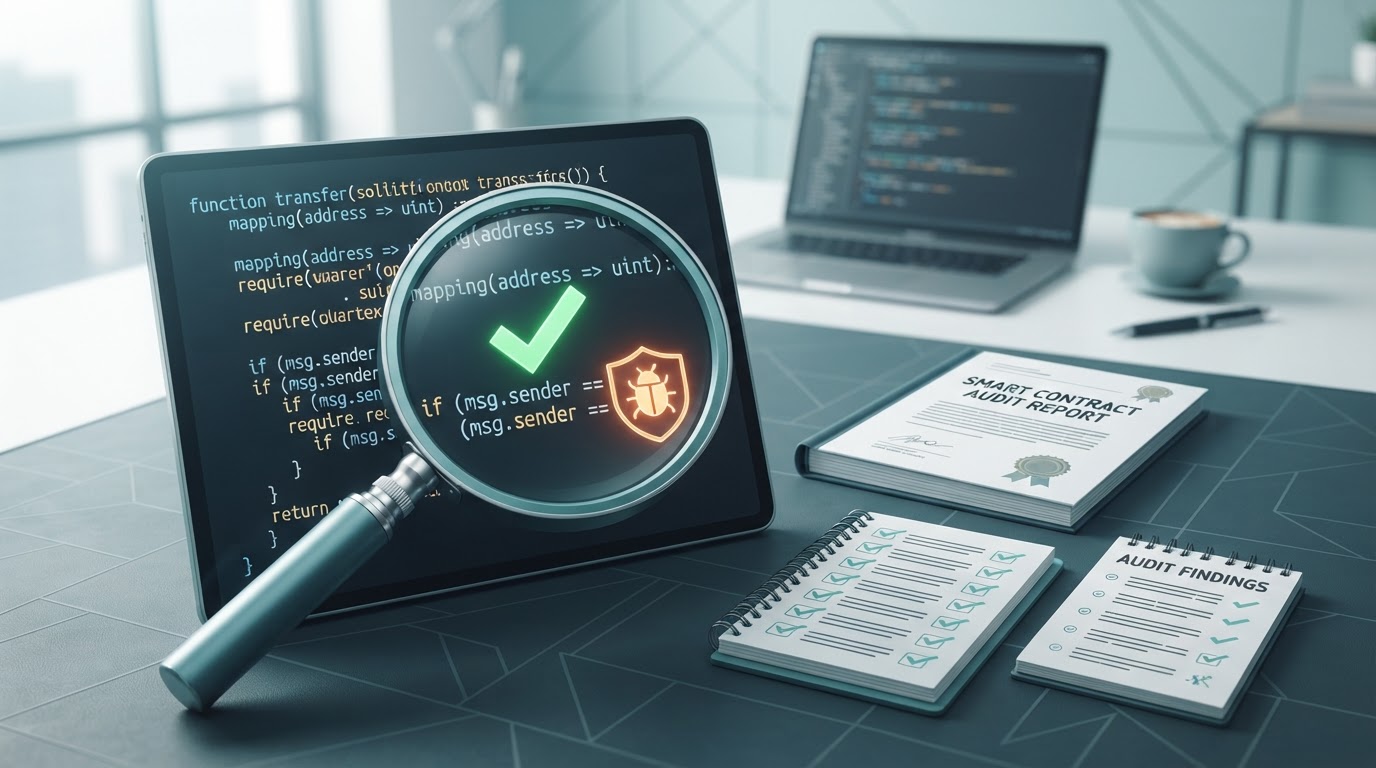
An audit reviews the contract code for known vulnerability classes: reentrancy, integer overflows and underflows, access-control flaws, uninitialized storage, front-running exposure, and logic errors in the token lifecycle — minting, transfers, whitelisting, distributions, and redemption. The auditor reads the code, writes tests, and reports findings by severity.
What an Audit Does Not Check
- The legal enforceability of the rights the token claims to convey
- Oracle and off-chain integration reliability
- Whether the contract matches the offering documents' intent
- Operational security of the issuer's keys and infrastructure
- Behavior under extreme market or governance conditions
Common Audit Findings
Audits routinely surface access-control issues, missing input validation, unsafe upgrade patterns, and logic that does not match the stated intent. Many findings are not exploitable in isolation but become problems when combined with other components. The remediation a team performs after the audit matters as much as the findings themselves.
Severity and Remediation
Findings are rated by severity — critical, high, medium, low, informational. Critical and high findings must be remediated before launch; medium findings should be; low and informational are improvements. A credible process remediates, re-audits the changes, and publishes the final report — not just the initial one.
Upgrade Controls and Administration
Many token contracts are upgradeable, which means an administrator can change the logic after deployment. An audit that does not cover the upgrade mechanism misses a major risk surface. Who can upgrade, under what conditions, and with what safeguards determines whether the audited code is the code that actually runs tomorrow.
The Limits of Code Review
An audit reviews a snapshot of code at a point in time. It does not guarantee the deployed code matches the audited code, it does not cover future changes, and it does not account for the human and operational factors that cause most real-world incidents. An audit is necessary but not sufficient.
What a Credible Audit Program Looks Like
Two independent audits from reputable firms, published in full, with all critical and high findings remediated and re-audited before mainnet. Ongoing monitoring for upgrades, and re-audit of any material change. An audit is part of a process — not a one-time certificate.
Audits Are a Layer, Not a Seal
Treat an audit as one layer in a broader assurance program, not as a seal of approval. Layer it with formal verification where the logic is critical, with upgrade controls that prevent silent changes, with monitoring that catches anomalous behavior, and with incident response that limits damage when something goes wrong. The teams that treat audits as the start of assurance — not the end — are the ones whose contracts hold up under conditions the auditor never tested. The audit is necessary. It is never sufficient.
Conclusion
A smart contract audit checks the code for known vulnerability classes and logic errors, but it does not guarantee safety, does not cover the legal wrapper, and does not account for operational risk. Read the full report, check the remediation, and treat the audit as one layer in a larger assurance program — not as a seal of approval.