Tokenizing Energy and Infrastructure Projects: From Construction to Cash Flow
Project financing, development risk, operating revenues, and investor rights.
Introduction
Energy and infrastructure projects — solar farms, wind assets, toll roads, transmission lines — have the long-duration, predictable cash flows that make them candidates for tokenization. This article explains project financing, development risk, operating revenues, and investor rights in infrastructure tokenization.
Project Financing
Capital is raised to fund construction or acquisition, often through an SPV that owns the project and issues the tokens. Equity investors fund the development; debt may sit on top, secured by the project's assets and revenues. The capital structure — seniority, leverage, reserves — determines how cash flow is allocated and how risk is distributed.
Development Risk
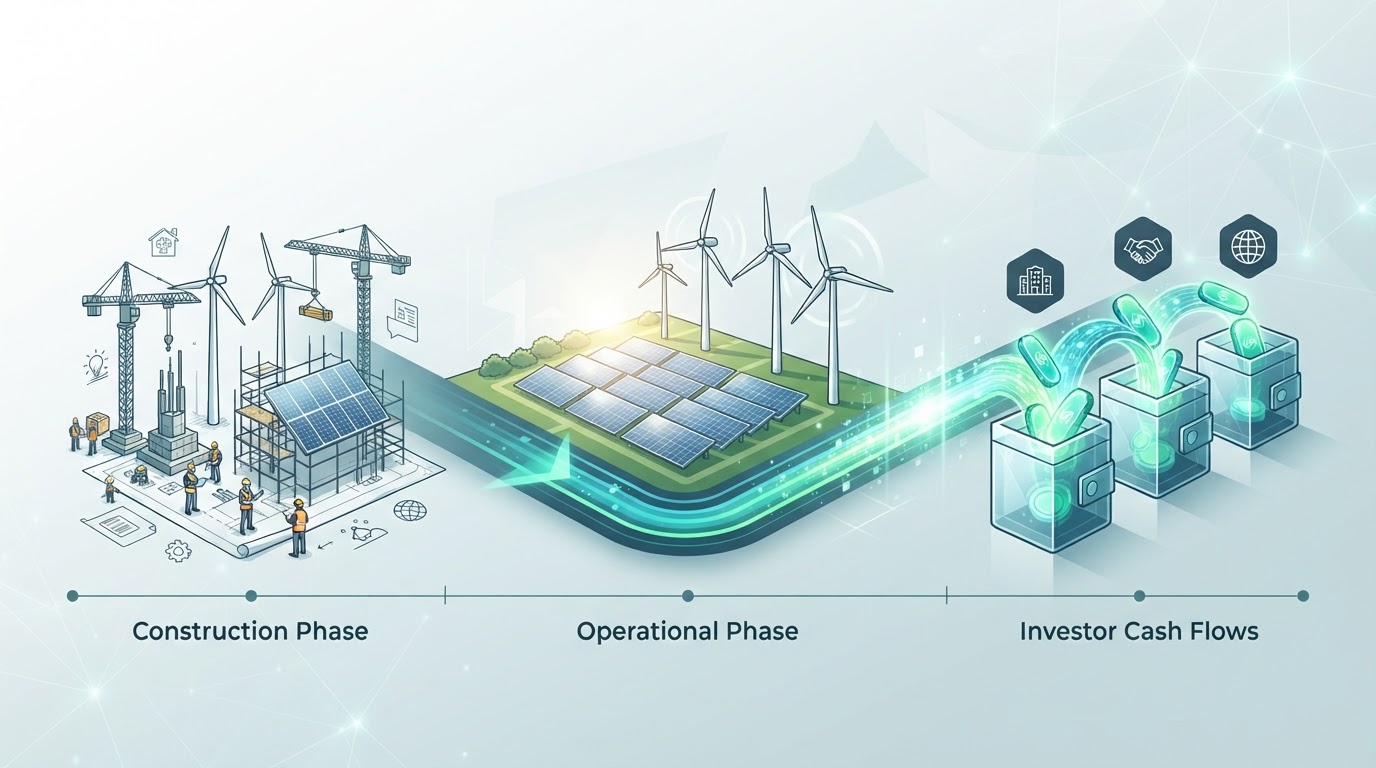
Before operations begin, a project carries construction risk: cost overruns, delays, permitting problems, and completion risk. During this phase there is no revenue, only spend. Investors funding development take on the risk that the project is never completed, or completed over budget. Development-stage and operating-stage investments carry very different risk profiles.
Operating Revenues
Once operational, revenue comes from power purchase agreements, tolls, capacity payments, or offtake contracts. These contracted revenues are what make infrastructure attractive: predictable, long-dated cash flows that can be distributed to tokenholders net of operating costs. The strength and creditworthiness of the offtaker underpin the investment.
Investor Rights
- Equity: residual claim after debt service, higher return and higher risk
- Debt: fixed coupon secured by project assets, priority in the waterfall
- Revenue-share: contractual right to a portion of top-line revenue
- Governance rights over major project decisions
- Information and audit rights over project financials
The Development-to-Operations Transition
The moment a project moves from construction to operation is the moment most risk concentrates. Cost overruns, delays, and performance shortfalls all surface here. A project that completes on budget and performs as modeled is a different investment than one that does not, and the transition is where investors should look hardest.
Cash Flow Waterfalls
Infrastructure cash flows follow a defined waterfall: operating costs, then senior debt service, then reserves, then junior debt, then equity distributions. Each token sits at a defined point in the waterfall, and its return depends on how much cash reaches that point. Modeling the waterfall under stress — not just the base case — is how investors assess true risk.
Reserves and Maintenance
Operating projects require maintenance reserves to fund repairs and lifecycle replacements. A project that distributes all its cash and keeps nothing for maintenance will underperform or fail. Reserve adequacy is a measure of management quality and a protection for investors.
Patience and Process
Infrastructure rewards patience and punishes optimism. The projects that deliver durable returns to tokenholders are the ones that were built on conservative construction budgets, realistic operating assumptions, adequate reserves, and sponsors with the discipline to hold cash back for maintenance rather than distributing it all. Tokenization can broaden access to these assets and improve the efficiency of distributions, but it cannot rescue a project whose fundamentals were weak at construction. Underwrite the asset first, then decide whether the blockchain adds value on top of it.
Conclusion
Tokenizing energy and infrastructure projects connects patient capital to long-duration assets with predictable cash flows, but the development-to-operations transition is where most risk concentrates. Understand the financing structure, the operating revenues, the investor rights, and the reserve posture before you invest — because infrastructure pays off over decades, and the structure has to survive that long.